

What if businesses no longer need to replace their contact center platform to deploy advanced AI?
For years, contact center modernization often meant migrating from legacy PBX systems to cloud-based CCaaS platforms.
Companies invested in new routing systems, agent desktops, reporting tools, and integrations.
But AI may be changing that equation.
On October 21, 2026, Microsoft introduced Contact Center Intelligence (CCI), a solution designed to bring AI agents, quality assurance, and analytics to existing contact center platforms.
Instead of replacing their current infrastructure, businesses can potentially add an intelligent AI layer on top.
This raises an important question:
Will the next generation of contact centers be defined by who owns the platform — or who owns the AI?
1 Microsoft's New Approach: AI Without Replacing CCaaS
Microsoft Contact Center Intelligence, currently in public preview, introduces AI capabilities that can integrate with third-party contact center systems.
Microsoft identifies platforms such as Five9, Cisco Webex Contact Center, and Avaya as integration options.
Its architecture includes three main AI components:
- Customer Assist Agent: Supports automated customer conversations and human-assisted service.
- Quality Assurance Agent: Evaluates interactions against quality, compliance, and performance criteria.
- Service Operations Agent: A planned capability for configuring, monitoring, and optimizing contact center operations.
The platform also connects with Microsoft business data, knowledge sources, and enterprise applications.
The important development isn't simply another AI customer service product.
It's the idea that enterprises can modernize their AI capabilities without rebuilding their entire contact center infrastructure.
This could significantly change how businesses evaluate their technology investments.
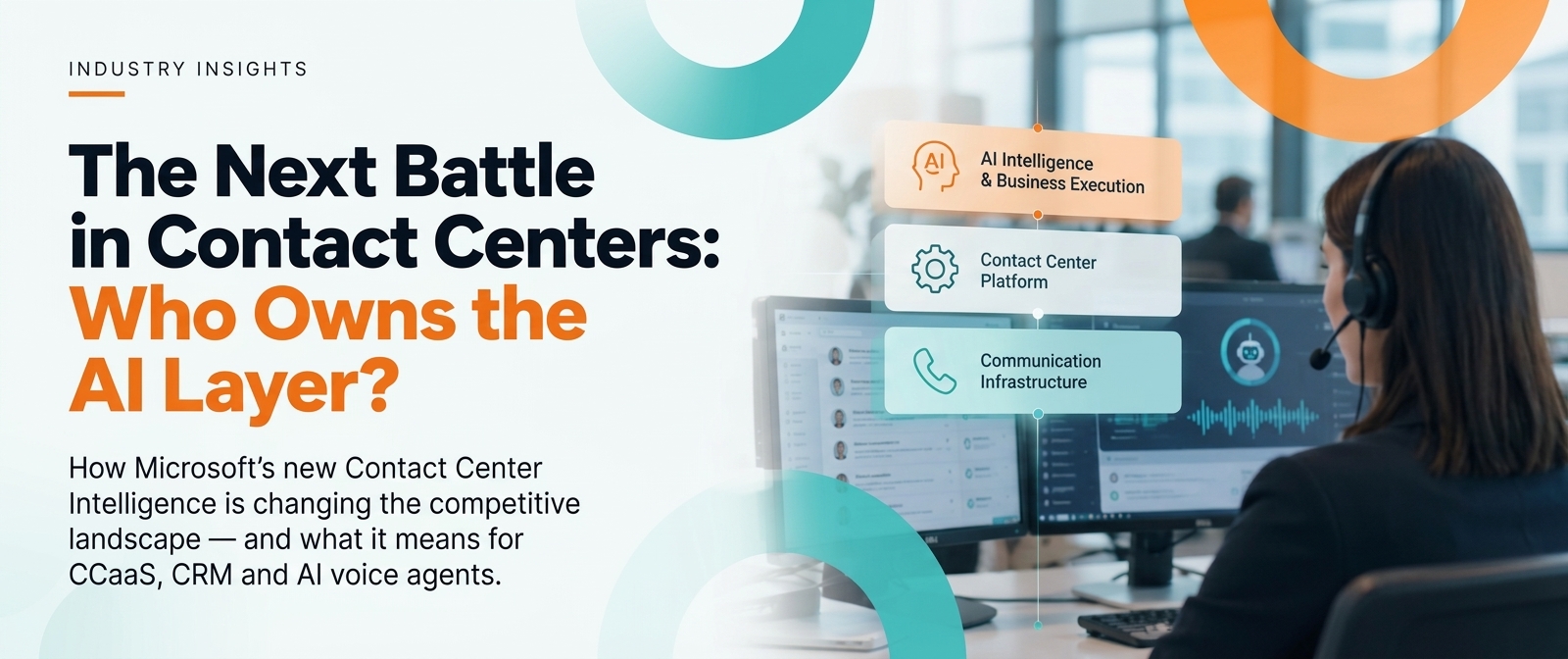
2 The Contact Center Is Becoming a Three-Layer Architecture
Traditionally, CCaaS platforms combined communication infrastructure, agent management, and customer service applications into a relatively integrated system.
AI introduces the possibility of separating these responsibilities.
A modern contact center can increasingly be viewed as three interconnected layers.
This layer handles the fundamental communication capabilities:
- Phone numbers and SIP trunks
- Inbound and outbound calling
- Call routing and connectivity
- Carrier management and failover
Reliable communication infrastructure remains essential, regardless of how intelligent the AI becomes.
This layer manages the operational environment:
- ACD and IVR
- Human agent management
- Queues and routing policies
- Recording, monitoring, and reporting
- Workforce and quality management
Platforms such as Genesys, NICE, Five9, and Talkdesk have built substantial capabilities around these functions.
This is where the market is evolving rapidly. AI voice agents can potentially:
- Understand customer intent
- Conduct natural conversations
- Retrieve customer information
- Execute approved business workflows
- Update CRM records
- Escalate complex requests to human agents
This layer may be provided by the existing CCaaS vendor, an external AI platform, or a combination of both.
The architecture isn't always strictly separated. Some vendors provide all three layers, while others specialize in individual components.
But the growing ability to integrate AI independently creates new choices for enterprises.
3 Why This Matters for Traditional CCaaS Vendors
The global CCaaS market remains healthy.
According to Metrigy's 2026 market research, global CCaaS revenue reached approximately $8.4 billion in 2025, growing around 16% year over year.
Cloud migration continues to create demand for modern contact center platforms.
But AI introduces a new competitive question.
If enterprises can purchase advanced AI capabilities separately, will they still rely exclusively on their CCaaS provider for innovation?
Consider two possible approaches.
Integrated AI
A company uses its CCaaS provider's native AI capabilities for automated conversations, analytics, and workflow execution.
This may simplify deployment, administration, and vendor accountability.
Independent AI Layer
A company retains its existing contact center platform but integrates a specialized AI voice agent solution.
This may offer greater flexibility, specialized functionality, or access to different AI technologies.
Neither approach is universally better.
The choice depends on integration complexity, cost, governance, performance, and business requirements.
However, independent AI platforms could put pressure on traditional CCaaS vendors to demonstrate why customers should purchase AI capabilities directly from them.
4 AI Outbound Calling Shows Why Flexibility Matters
Outbound calling is a particularly interesting example.
Many businesses already have telephony infrastructure, CRM systems, and sales teams.
They may not need to replace their entire contact center to automate specific workflows.
Instead, they may want AI voice agents to handle tasks such as:
- Lead qualification
- Appointment reminders
- Customer follow-ups
- Payment reminders
- Renewal notifications
For example, a company might retain its existing SIP connectivity and CRM while introducing AI to handle routine outbound conversations.
When a prospect shows genuine interest, the AI can transfer the interaction to a human sales representative, provided the integration supports the required routing and context transfer.
This creates a more modular approach to automation.
Businesses can start with a specific use case rather than committing to a complete platform migration.
However, integration quality matters.
Connecting an AI voice agent to an existing phone system is only the first step. Successful deployment also requires reliable call control, data synchronization, workflow execution, monitoring, and appropriate consent and compliance controls.
5 The Real Challenge: Who Controls the Customer Workflow?
Separating AI from the underlying contact center creates flexibility.
It also introduces complexity.
Imagine an AI voice agent handling a customer renewal conversation.
The agent needs to retrieve account information, verify identity where necessary, understand renewal conditions, and potentially update the CRM.
If the customer raises a complex issue, the conversation may need to move to a human representative.
Several systems are involved:
- The telephony platform manages the call.
- The AI platform manages the conversation.
- The CRM stores customer information.
- Business applications execute approved actions.
- The contact center manages human escalation.
Core Architectural Dilemmas
- Who coordinates the entire process?
- Who determines whether an action is authorized?
- Who maintains the conversation history?
- And who is responsible when something fails?
These questions reveal why AI orchestration may become one of the most valuable capabilities in the next generation of contact centers.
The winning solution may not simply have the most natural voice or fastest response time.
It may be the one that reliably connects conversations, customer data, business rules, and human teams.
6 A New Competition Over Contact Center Revenue
Microsoft's announcement also raises questions about future pricing models.
Traditional CCaaS revenue has often been closely linked to agent licenses and platform subscriptions.
AI introduces additional models, including usage-based pricing and, in some cases, outcome-related pricing.
Microsoft CCI, for example, uses a consumption-based model through Copilot Credits. Existing contact center providers may still charge separately for platform access or voice-channel integration.
This means adding an independent AI layer does not automatically reduce costs.
Enterprises need to consider the total cost of:
- Existing CCaaS licenses
- AI conversation processing
- Telephony and carrier charges
- Integration and maintenance
- Human escalation
- Monitoring and compliance
The commercial opportunity is significant, but so is the need for transparent cost measurement.
For traditional CCaaS vendors, AI may generate additional revenue.
For independent AI providers, it creates an opportunity to deliver value without owning the entire contact center platform.
For enterprises, the key question becomes:
Which combination of technologies delivers the best business outcomes at an acceptable total cost?
7 What Comes Next?
Microsoft Contact Center Intelligence is still in public preview, so its long-term market impact remains uncertain.
But its introduction highlights a broader architectural shift.
Contact centers are becoming more modular, and AI is increasingly capable of operating across existing enterprise systems.
This could lead to several developments:
- More hybrid architectures. Enterprises may combine traditional CCaaS platforms with specialized AI voice solutions.
- Greater emphasis on interoperability. APIs, SIP integration, CRM connectivity, and reliable human handoff may become more important purchasing criteria.
- More competition around AI orchestration. CCaaS vendors, CRM providers, and independent AI platforms may compete to coordinate customer workflows.
- A stronger focus on business outcomes. Enterprises may evaluate AI based on successful task completion, cost per resolution, qualified leads, and customer experience rather than conversation volume alone.
References
- 1. Microsoft, October 21, 2026 — Microsoft Contact Center Intelligence: Transforming Customer Experience at Agentic Speed
- 2. Constellation Research, October 21, 2026 — Microsoft Launches Contact Center Intelligence in Public Preview
- 3. The Futurum Group, October 22, 2026 — Microsoft Contact Center Intelligence Takes Aim at CCaaS AI
- 4. Metrigy — 2026 CCaaS Market Research, global market estimates and forecasts.


