

Cash on Delivery (COD) remains an important payment method in many e-commerce markets, particularly in Southeast Asia, the Middle East, Africa, and Latin America.
While COD makes online shopping more accessible, it also creates a significant challenge for e-commerce businesses: customers place orders, but not all of them accept the delivery.
Every unsuccessful delivery can mean lost revenue, wasted shipping costs, additional return expenses, and unnecessary inventory pressure.
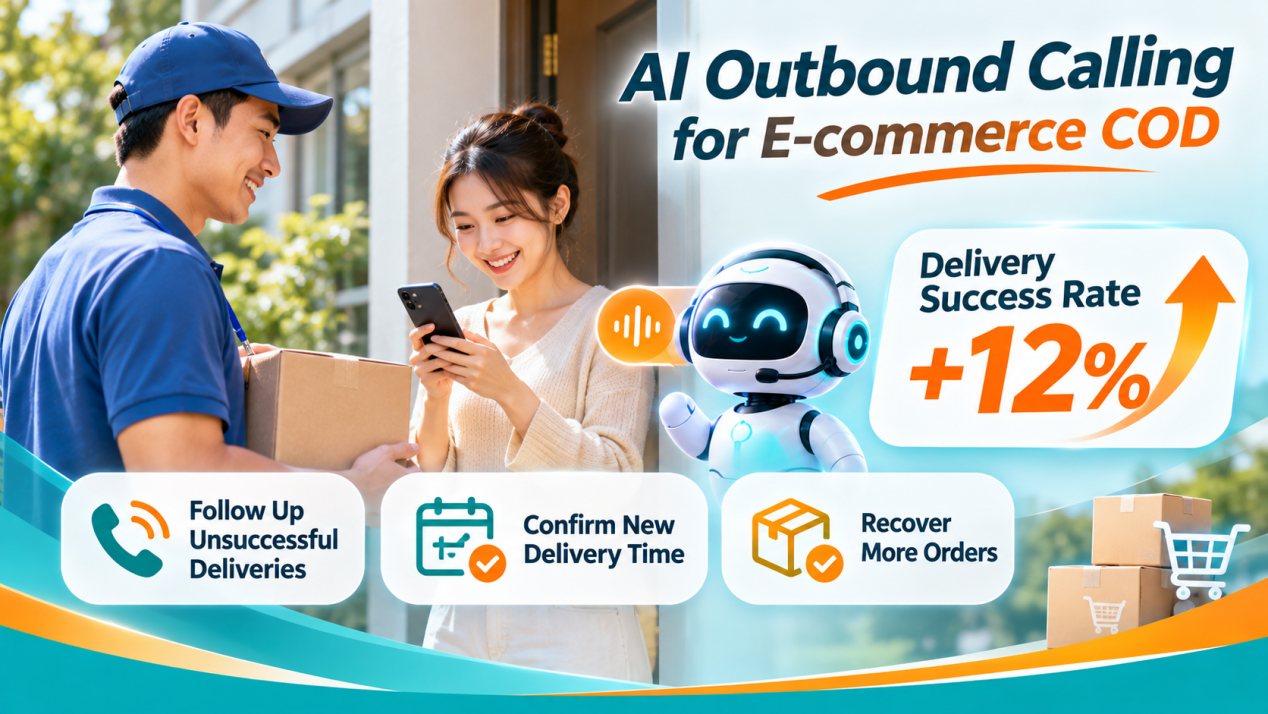
For one e-commerce business, Kontactix AI outbound calling helped turn this challenge into a measurable business opportunity, increasing the successful delivery rate by 12%.
1 The Challenge: Failed Deliveries Mean Lost Revenue
When a COD order fails to reach a customer, the reasons can vary:
- The customer was unavailable during delivery.
- The delivery address was incorrect or incomplete.
- The customer did not have sufficient cash available.
- The customer missed the courier's phone call.
- The customer wanted to reschedule the delivery.
- The customer had changed their mind about the purchase.
Many of these orders are still recoverable.
However, manually following up on every unsuccessful delivery is time-consuming and difficult to scale, especially during major promotional campaigns.
By the time a customer service agent makes the follow-up call, the package may already be on its way back to the warehouse.
2 The Solution: AI-Powered Failed Delivery Follow-Up
The e-commerce business introduced Kontactix AI outbound calling into its COD delivery management workflow.
Instead of waiting for customers to contact customer service, AI voice agents proactively reach out when an unsuccessful delivery is identified.
Real-Time Follow-Up on Failed Deliveries
Once the logistics system reports an unsuccessful delivery, an automated outbound call can be triggered.
The AI voice agent contacts the customer, confirms the order information, and asks why the package was not accepted.
Timely communication creates an opportunity to recover the order before it is returned.
Intelligent Identification of Delivery Failure Reasons
Through natural voice conversations, AI identifies and categorizes the reasons behind unsuccessful deliveries.
Different situations can trigger different follow-up actions:
| Reason | Follow-Up Action |
|---|---|
| Customer unavailable | Confirm a new delivery time |
| Incorrect address | Collect updated address information |
| Insufficient cash | Confirm when payment will be available |
| Missed courier call | Remind the customer to expect another call |
| Product concerns | Escalate to customer service |
| Order cancellation | Record the cancellation reason |
This allows the business to take targeted action rather than simply attempting another delivery.
Delivery Rescheduling and Order Recovery
For customers who still intend to purchase, AI voice agents can confirm their preferred delivery time and collect the necessary information for a second delivery attempt.
The results can be shared with the logistics or customer service system, helping delivery teams prioritize recoverable orders.
Automated Data Collection and Analysis
Every conversation provides valuable operational insights.
By analyzing failed delivery reasons, e-commerce businesses can identify recurring problems, improve logistics operations, optimize delivery schedules, and better understand customer behavior.
3 The Results: A 12% Increase in Successful Delivery Rate
The introduction of AI outbound calling helped the business achieve:
For high-volume e-commerce businesses, even a modest improvement in delivery success can generate substantial financial benefits.
4 The Financial Impact: A 12% Improvement Could Recover Millions in Annual Sales
Consider an illustrative e-commerce business with the following monthly order volume:
| Metric | Before AI | After AI |
|---|---|---|
| Monthly COD orders | 100,000 | 100,000 |
| Successful delivery rate | 70% | 78.4% |
| Successfully delivered orders | 70,000 | 78,400 |
| Average order value | $30 | $30 |
| Monthly realized sales | $2,100,000 | $2,352,000 |
Potential financial impact:
These figures do not include potential savings from reduced return shipping, warehouse handling, inventory management, and manual follow-up costs.
The financial impact can be even more significant for businesses processing hundreds of thousands of COD orders every month.


