

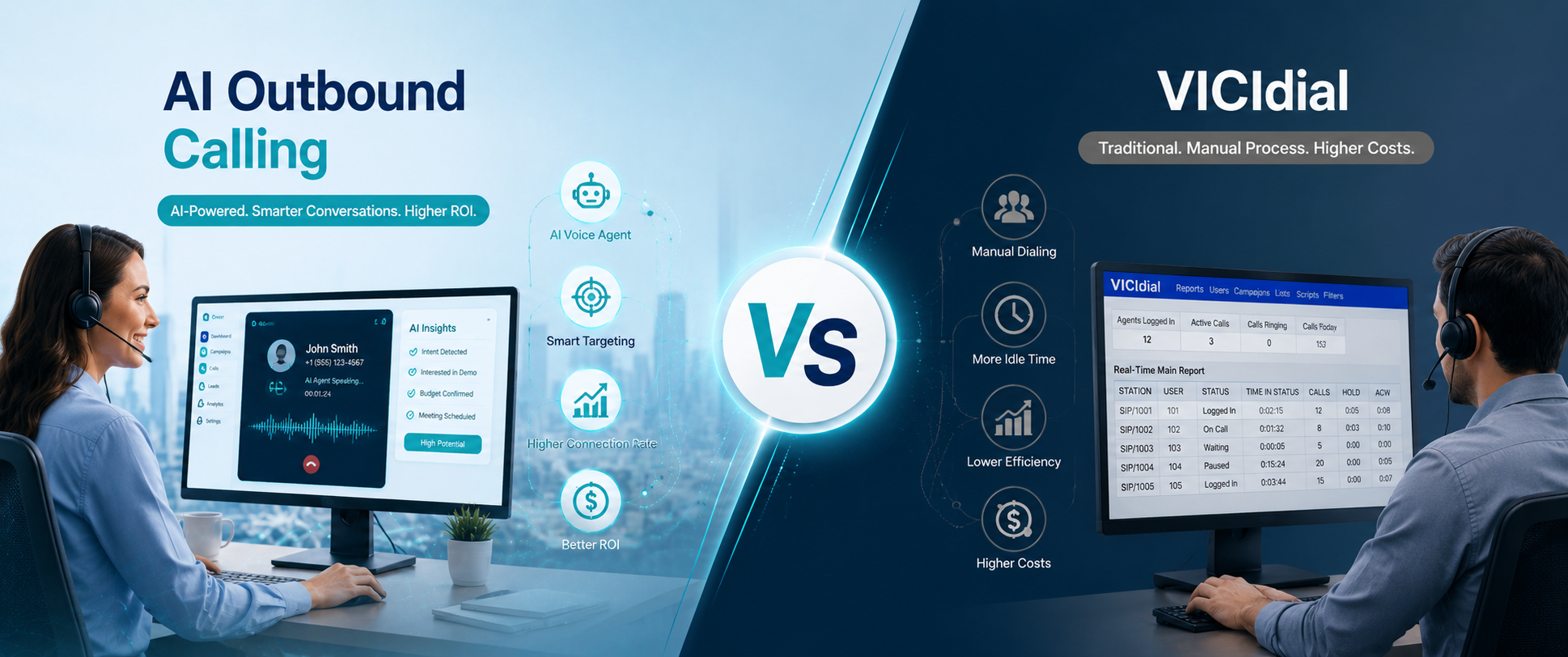
AI Is Changing Outbound Calling
For more than 20 years, outbound call centers have relied on predictive dialers like VICIdial to improve agent productivity.
Instead of dialing one number at a time, predictive dialers automatically call customers and connect answered calls to available agents.
It was revolutionary.
But today, the challenge isn't just dialing more numbers.
Businesses want to:
- Reach 10× more prospects
- Reduce labor costs
- Operate 24/7
- Automatically qualify leads
- Book appointments
- Integrate with CRM
- Generate more revenue
That's why AI outbound calling has become one of the fastest-growing technologies in contact centers.
So how does it compare with VICIdial?
Let's take a closer look.
What Is VICIdial?
VICIdial is one of the world's most popular open-source outbound call center platforms.
Built on Asterisk, it provides:
- Predictive Dialer
- Progressive Dialer
- Preview Dialer
- Manual Dialing
- Campaign Management
- Call Recording
- Agent Monitoring
- Basic Reporting
Instead of agents manually dialing every customer, VICIdial automatically connects answered calls to available agents.
It significantly increases agent efficiency.
Thousands of BPOs and telemarketing companies still use it today.

What Is AI Outbound Calling?
AI outbound calling takes automation one step further.
Instead of simply connecting calls to human agents, AI voice agents can actually conduct conversations.
Powered by:
- Speech Recognition (ASR)
- Large Language Models (LLMs)
- Text-to-Speech (TTS)
- AI Intent Detection
AI can:
- Introduce products
- Answer FAQs
- Qualify leads
- Schedule appointments
- Handle objections
- Update CRM
- Transfer only high-intent customers to sales agents
Instead of helping agents dial faster...
AI actually performs much of the conversation itself.
Feature Comparison
| Feature | VICIdial | AI Outbound Calling |
|---|---|---|
| Auto Dialing | ✅ | ✅ |
| Predictive Dialer | ✅ | ✅ |
| Human Agent Required | Always | Only when needed |
| AI Voice Agent | ❌ | ✅ |
| Lead Qualification | Manual | Automatic |
| Appointment Booking | Manual | AI Automated |
| CRM Update | Limited | Automatic |
| Conversation Analysis | Limited | AI Insights |
| 24/7 Operation | Depends on staffing | ✅ |
| Multi-language Support | Basic | AI Native |
| Script Optimization | Manual | AI-assisted |
| Real-time Intent Detection | ❌ | ✅ |
How They Actually Work
Every answered call requires a human agent.
No agent?
The customer waits or the call may be abandoned.
Human agents only spend time on qualified opportunities.
Best Use Cases
- Traditional call centers
- BPO companies
- Collections
- Existing telemarketing teams
- Organizations with many human agents
- Businesses with technical teams
- Lead generation
- Telemarketing
- Appointment booking
- Customer follow-up
- Debt collection
- Customer surveys
- Insurance sales
- Real estate
- Education enrollment
- Healthcare reminders
If your goal is improving agent productivity, VICIdial remains a reliable option.
Any campaign involving repetitive conversations can usually benefit from AI.

Deployment Comparison
VICIdial
Deployment usually requires:
- Linux server
- Asterisk
- Database configuration
- SIP trunk setup
- Campaign configuration
- Dialplan tuning
A typical deployment may take several days or even weeks, especially for organizations without experienced Linux or VoIP engineers.
AI Outbound Platform
Modern AI outbound platforms are generally cloud-native.
Typical setup includes:
- Account creation
- SIP trunk connection
- Import contacts
- Configure AI scripts
- Connect CRM
- Launch campaign
Many businesses can begin testing within hours rather than weeks.
Advantages and Disadvantages
| Platform | Advantages | Disadvantages / Considerations |
|---|---|---|
| VICIdial | • Mature and stable • Free and open source • Large community • Flexible customization |
• Requires Linux expertise • Human-agent dependent • Manual campaign optimization |
| AI Outbound Calling | • Human-like conversations • Handles conversations automatically • 24/7 operation • Massive scalability |
• Requires AI script optimization • Higher software investment • Better long-term ROI |
Cost, Capacity & ROI Comparison
Software cost is only one part of the equation. The real cost of an outbound call center comes from people, infrastructure, office space, training, and ongoing operations.
The comparison below illustrates a typical outbound operation.
* Note: Below data is based on industry averages; actual results may vary by country, industry, salary, and script quality.
Example 1: 10-Agent Outbound Call Center
Assumptions:
- Human agent salary: $800/month
- Working days: 22 days/month
- Average calls per agent/day: 200
- Qualified lead rate: 2%
- AI Outbound Calling subscription: $299/month
- AI concurrency: 100 simultaneous calls
| Item | VICIdial + Human Agents | AI Outbound Calling |
|---|---|---|
| Software License | Free (Open Source) | $299/month |
| Deployment & Maintenance | Linux engineer required | Included |
| Human Agents | 10 | 0–2 supervisors |
| Monthly Agent Cost | $8,000 | $0–1,600 |
| Daily Call Capacity | 2,000 | 40,000+ |
| Monthly Calls | 44,000 | 880,000+ |
| Qualified Leads (2%) | ~880 | 17,600+ |
| Available 24/7 | ❌ | ✅ |
| Automatic Appointment Booking | ❌ | ✅ |
| AI Lead Qualification | ❌ | ✅ |
Key Takeaway: With the same monthly software investment, AI can reach 20× more prospects and generate significantly more qualified leads while reducing labor costs dramatically.
Example 2: 100-Agent Outbound Call Center
Now let's look at a larger BPO or enterprise sales team.
Assumptions:
- 100 human agents
- $800/month salary
- Same conversion assumptions
| Item | VICIdial + Human Agents | AI Outbound Calling |
|---|---|---|
| Human Agents | 100 | 5–10 supervisors |
| Monthly Labor Cost | $80,000 | $4,000–8,000 |
| Daily Calls | 20,000 | 40,000+ |
| Monthly Calls | 440,000 | 880,000+ |
| Qualified Leads | ~8,800 | 17,600+ |
| Recruiting Required | Continuous | Minimal |
| Staff Turnover Risk | High | Very Low |
| Training Cost | High | Minimal |
| Operating Hours | Business Hours | 24×7 |
Although a 100-agent team can generate significant call volume, it also brings high recruitment, training, and management costs. AI enables similar—or greater—calling capacity with a much smaller operational team.

AI Changes the Economics of Outbound Calling
Traditional outbound call centers are built around human capacity.
- More customers → Hire more agents.
- More campaigns → Recruit more people.
- Longer hours → Pay overtime.
AI outbound calling breaks this model.
With one $299/month subscription, you can run up to 100 concurrent AI voice agents, capable of handling the workload equivalent to around 100 human agents for repetitive outbound conversations such as:
- Lead qualification
- Appointment booking
- Trial class reminders
- Payment reminders
- Customer surveys
- Follow-up calls
- Reactivation campaigns
Human agents are only involved when AI detects high purchase intent or when complex conversations require personal assistance.
Which Delivers Better ROI?
For businesses making fewer than 500 outbound calls per day, a traditional predictive dialer like VICIdial may still be a practical choice.
However, once outbound volume reaches several thousand calls per day, labor costs become the dominant expense.
At that point, AI outbound calling offers a fundamentally different ROI model:
- Up to 20× higher daily call capacity
- 10× more qualified leads with the same sales team
- 24/7 campaign execution
- Up to 80% lower labor costs
- No recruiting bottlenecks
- Faster campaign launches
- Consistent customer experience
Instead of asking "How many agents do we need?", businesses can now ask "How many conversations do we want to have?" That's the shift AI brings to modern outbound operations.
Can They Work Together?
Absolutely.
Many organizations continue using VICIdial as the dialing platform while integrating AI voice agents for specific campaigns.
A common migration path looks like this:
- Continue using VICIdial for complex sales calls.
- Deploy AI voice agents for lead qualification, reminders, surveys, and appointment booking.
- Transfer qualified prospects from AI to experienced sales representatives.
- Expand AI usage gradually as confidence grows.
This hybrid approach allows businesses to modernize their outbound operations without replacing existing infrastructure overnight.
Which One Should You Choose?
- You already have a large outbound team.
- You have Linux/VoIP engineers in-house.
- You need a highly customizable, open-source platform.
- Your primary goal is improving agent dialing efficiency.
- You want to automate repetitive outbound conversations.
- Labor costs are rising.
- You need to contact significantly more customers.
- You want 24/7 availability.
- You aim to increase qualified leads without hiring more agents.
- You want AI to work alongside your sales team rather than simply helping them dial faster.
Final Thoughts
VICIdial transformed outbound calling by making human agents more productive. AI outbound calling represents the next evolution—automating not just the dialing, but the conversation itself.
The two technologies are not direct competitors in every scenario. For many organizations, the most effective strategy is to combine proven outbound dialing with AI voice agents, allowing human sales representatives to focus on high-value conversations while AI handles the repetitive work.
As AI voice technology continues to mature, outbound call centers are shifting from "more calls per agent" to "more qualified conversations with fewer resources." That shift is likely to define the future of outbound customer engagement.


